
Publications

- Home
- Publications
- Research Publications
- Recurrence and relapse in nonsegmental vitiligo: phenotypic and autoimmune predictors from a large retrospective cohort
Recurrence and relapse in nonsegmental vitiligo: phenotypic and autoimmune predictors from a large retrospective cohort
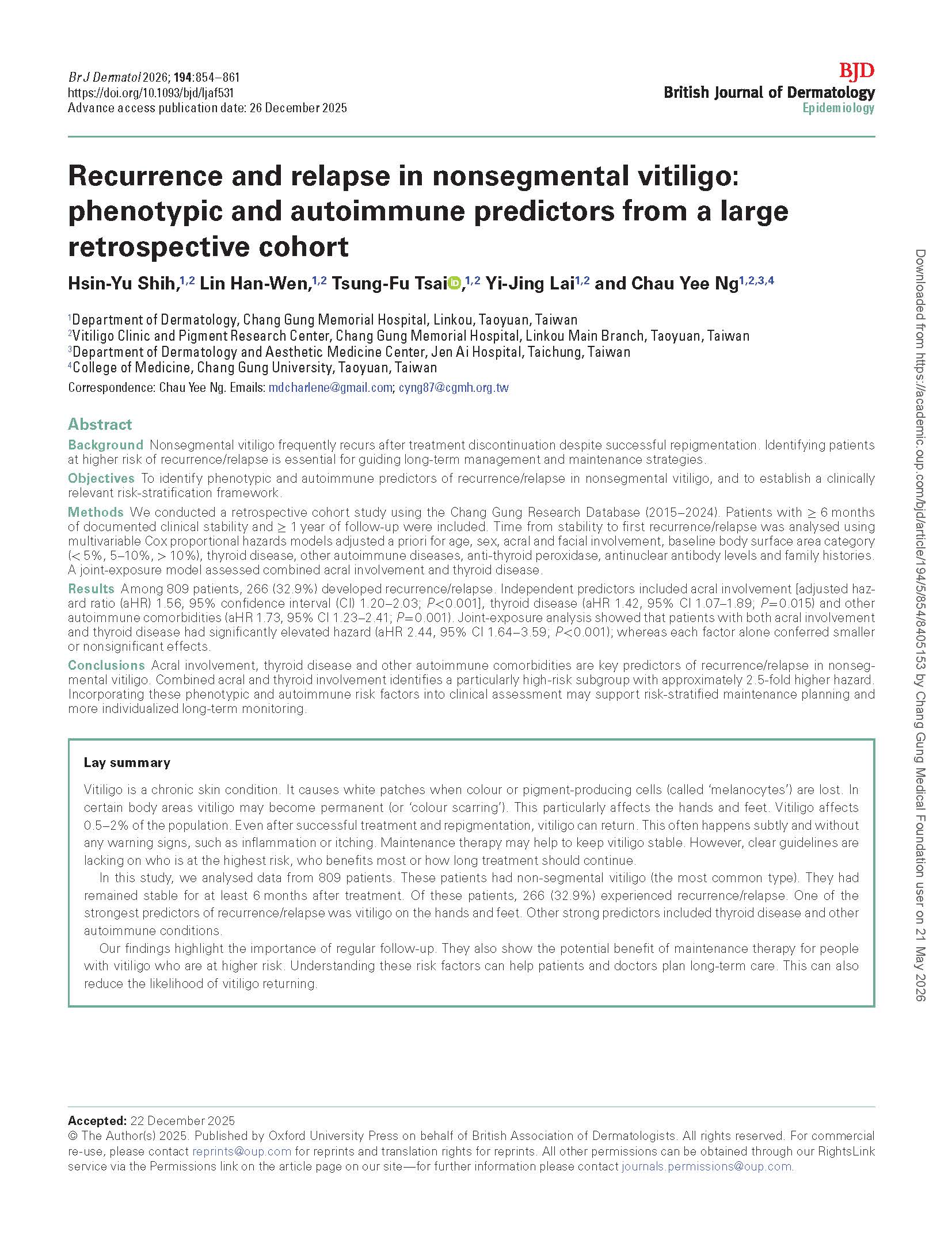
Vitiligo is a chronic skin condition. It causes white patches when colour or pigment-producing cells (called ‘melanocytes’) are lost. In certain body areas vitiligo may become permanent (or ‘colour scarring’). This particularly affects the hands and feet. Vitiligo affects 0.5–2% of the population. Even after successful treatment and repigmentation, vitiligo can return. This often happens subtly and without any warning signs, such as inflammation or itching. Maintenance therapy may help to keep vitiligo stable. However, clear guidelines are lacking on who is at the highest risk, who benefits most or how long treatment should continue. In this study, we analysed data from 809 patients. These patients had non-segmental vitiligo (the most common type). They had remained stable for at least 6 months after treatment. Of these patients, 266 (32.9%) experienced recurrence/relapse. One of the strongest predictors of recurrence/relapse was vitiligo on the hands and feet. Other strong predictors included thyroid disease and other autoimmune conditions. Our findings highlight the importance of regular follow-up. They also show the potential benefit of maintenance therapy for people with vitiligo who are at higher risk. Understanding these risk factors can help patients and doctors plan long-term care. This can also reduce the likelihood of vitiligo returning.
DOI: 10.1093/bjd/ljaf531
DOI: 10.1093/bjd/ljaf531
FAQ Classification
Related FAQ
- Quantitative CRFF-OCT Imaging Features for Characterization of Disease Activity in Non-Segmental Vitiligo: A Machine Learning–Assisted Study
- A comparative study of an advanced skin imaging system in diagnosing facial pigmentary and inflammatory conditions
- From zero to one: Recent advances in the pathogenesis, diagnosis, and treatment of vitiligo.
- Skin Interstitial Fluid and Plasma Multiplex Cytokine Analysis Reveals IFN-γ Signatures and Granzyme B as Useful Biomarker for Activity, Severity and Prognosis Assessment in Vitiligo
- Targeting the elevated IFN - γ in vitiligo patients by human anti - IFN - γ monoclonal antibody hampers direct cytotoxicity in melanocyte
- Pathogenic autoantibodies to IFN-γ act through the impedance of receptor assembly and Fc-mediated response
- Feasibility of Oral Tranexamic acid (TA) for Vitiligo Patients with Melasma
- A comparative study of suction blister epidermal grafting and automated blister epidermal micrograft in stable vitiligo
- Efficacy and safety of automated epidermal micrograft in patients with stable segmental and nonsegmental vitiligo
- Feasibility of High-Cellular-Resolution Full-Field, Artificial-Intelligence-Assisted, Real-Time Optical Coherence Tomography in the Evaluation of Vitiligo: A Prospective Longitudinal Follow-Up Study.