
Blog

- Home
- Blog
- Public Health Education
- Vitamin D and Vitiligo: Clinical Evidence and Considerations
Vitamin D and Vitiligo: Clinical Evidence and Considerations
April 12,2026
In recent clinical practice, an increasing number of patients with vitiligo have reported encountering online claims suggesting that “high-dose vitamin D supplementation can treat vitiligo.” However, such claims may be overly simplistic and potentially misleading.
While vitamin D plays an important role in immune regulation and skin health, supplementation does not equate to treatment, and higher intake does not necessarily lead to better outcomes.
1. Why Do Patients with Vitiligo Often Have Low Vitamin D Levels?
Studies have shown that patients with vitiligo and other autoimmune diseases are more likely to have vitamin D deficiency. Several contributing factors have been proposed:
- Reduced sun exposure: Patients often avoid sunlight to prevent sunburn or worsening contrast between lesional and non-lesional skin, limiting cutaneous vitamin D synthesis
- Chronic inflammatory state: Persistent immune activation may alter vitamin D metabolism and increase its consumption
- Lifestyle and stress factors: Daily habits and psychological stress may also influence serum vitamin D levels
Reference: Upala S et al. Vitamin D and vitiligo: A systematic review and meta-analysis. (PMID: 27005676)
.png)
2. Sources and Biological Functions of Vitamin D3
Sources:
- Ultraviolet B (UVB) exposure (cutaneous synthesis)
- Dietary intake (e.g., fatty fish, egg yolk)
- Nutritional supplements
Immune-modulating effects:
- Regulation of T cells (suppression of Th1 and Th17 pathways)
- Reduction of autoimmune responses
- Protection of melanocytes
- Anti-inflammatory effects
Vitamin D has also been associated with multiple systemic conditions, including osteoporosis, cardiovascular disease, autoimmune disorders, and mood disorders. However, most of these findings represent associations rather than proven causal relationships.
3. Effects of Vitamin D Deficiency
General effects:
- Fatigue and muscle weakness
- Increased risk of osteoporosis
- Higher susceptibility to infections
Autoimmune-related effects:
- Increased vitiligo activity
- Elevated inflammatory signaling
- Impaired immune regulation
➡ These changes may render melanocytes more vulnerable to immune-mediated damage
It is important to emphasize that vitamin D serves as a supportive immunomodulatory factor rather than a primary treatment for vitiligo.
4. Why Excess Supplementation Should Be Avoided
Vitamin D is a fat-soluble vitamin and can accumulate in the body. Excessive intake may lead to:
- Hypercalcemia
- Kidney stones
- Renal impairment
- Cardiac arrhythmias
Therefore, it is recommended to:
- Measure baseline serum 25(OH)D levels before supplementation
- Monitor levels periodically during supplementation
Reference: Bruce W. Circulating vitamin D3 and 25-hydroxyvitamin D in humans: An important tool to define adequate nutritional vitamin D status. (PMID: 17218096)

5. Recommended Intake
According to the National Institutes of Health (NIH) Vitamin D Fact Sheet:
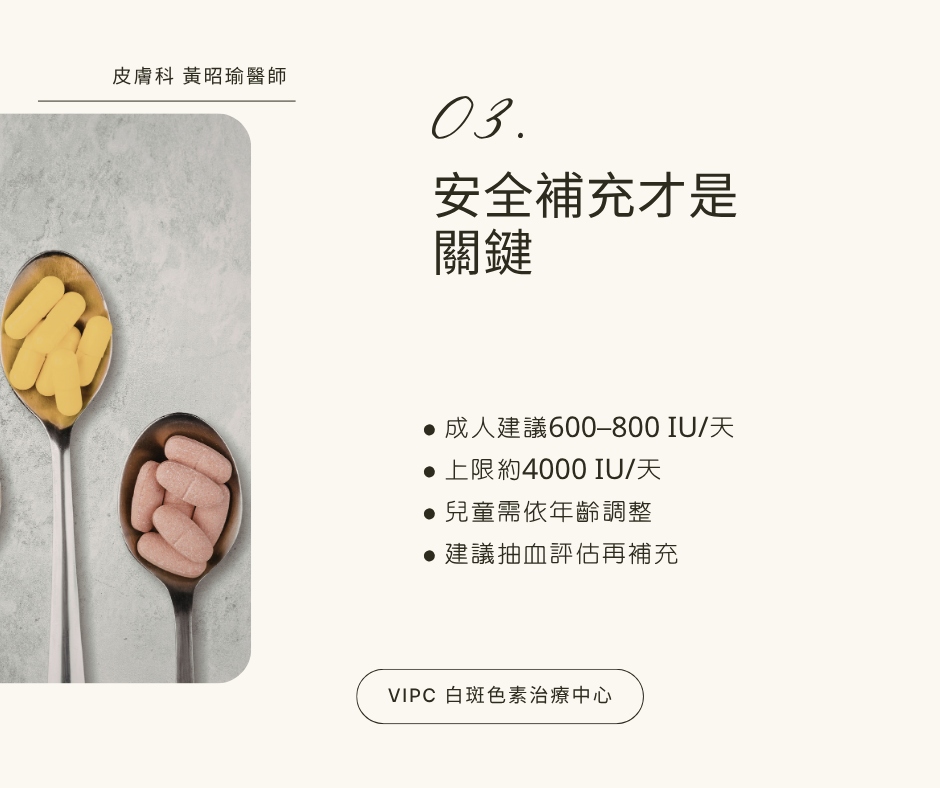
Adults:
- Recommended intake: 600–800 IU/day
- Upper limit: 4000 IU/day
Children:
- 0–12 months: 400 IU/day (upper limit: 1000–1500 IU)
- 1–18 years: 600 IU/day (upper limit: 2500–4000 IU, depending on age)
⚠️ Particular caution is required to avoid excessive supplementation in children
6. Interaction Between Vitamin D and Calcium
Vitamin D enhances calcium absorption and supports bone health. However, concurrent high intake of both vitamin D and calcium may increase the risk of:
- Hypercalcemia
- Kidney stones
Reference: Bruce W. Circulating vitamin D3 and 25-hydroxyvitamin D in humans: An important tool to define adequate nutritional vitamin D status. (PMID: 21796828)
Conclusion
Vitiligo is a disorder associated with immune dysregulation.
Vitamin D plays a role as an immunomodulatory factor, but it is not a definitive treatment for vitiligo.
- Appropriate supplementation may help restore physiological balance
- Excessive intake may pose systemic health risks
Particularly in pediatric populations, a precision-based supplementation approach is strongly recommended over indiscriminate high-dose use.
Clinical Recommendations
For individuals considering vitamin D supplementation:
- Assess baseline levels before supplementation
- Supplement appropriately based on clinical need
- Monitor regularly to ensure safety and effectiveness
This approach allows for safe, evidence-based, and sustainable long-term health management.
Additional References:
•Jabbari A et al. Effect of vitamin D3 supplementation on systemic inflammation and disease-specific markers in patients with autoimmune diseases: a comprehensive meta-analysis of randomized controlled trials. (PMID: 41952022)
•Usha Sri A et al. Association of Serum Vitamin D3 Levels With Vitiligo. (PMID: 40772169)
•Lu J et al. Effects of vitamin D supplementation on patients with systemic lupus erythematosus: A systematic review and meta-analysis.(PMID: 41951148)
•Richa et al. The role of vitamin D deficiency in psychiatric disorders: A systematic review on association with depression and schizophrenia. (PMID: 41940453)