
News & Events

- Home
- News
- Center Updates
- Vitiligo Center Develops an AI-Assisted CRFF-OCT Model for Objective Assessment of Disease Activity in Vitiligo
Vitiligo Center Develops an AI-Assisted CRFF-OCT Model for Objective Assessment of Disease Activity in Vitiligo
July 26,2026
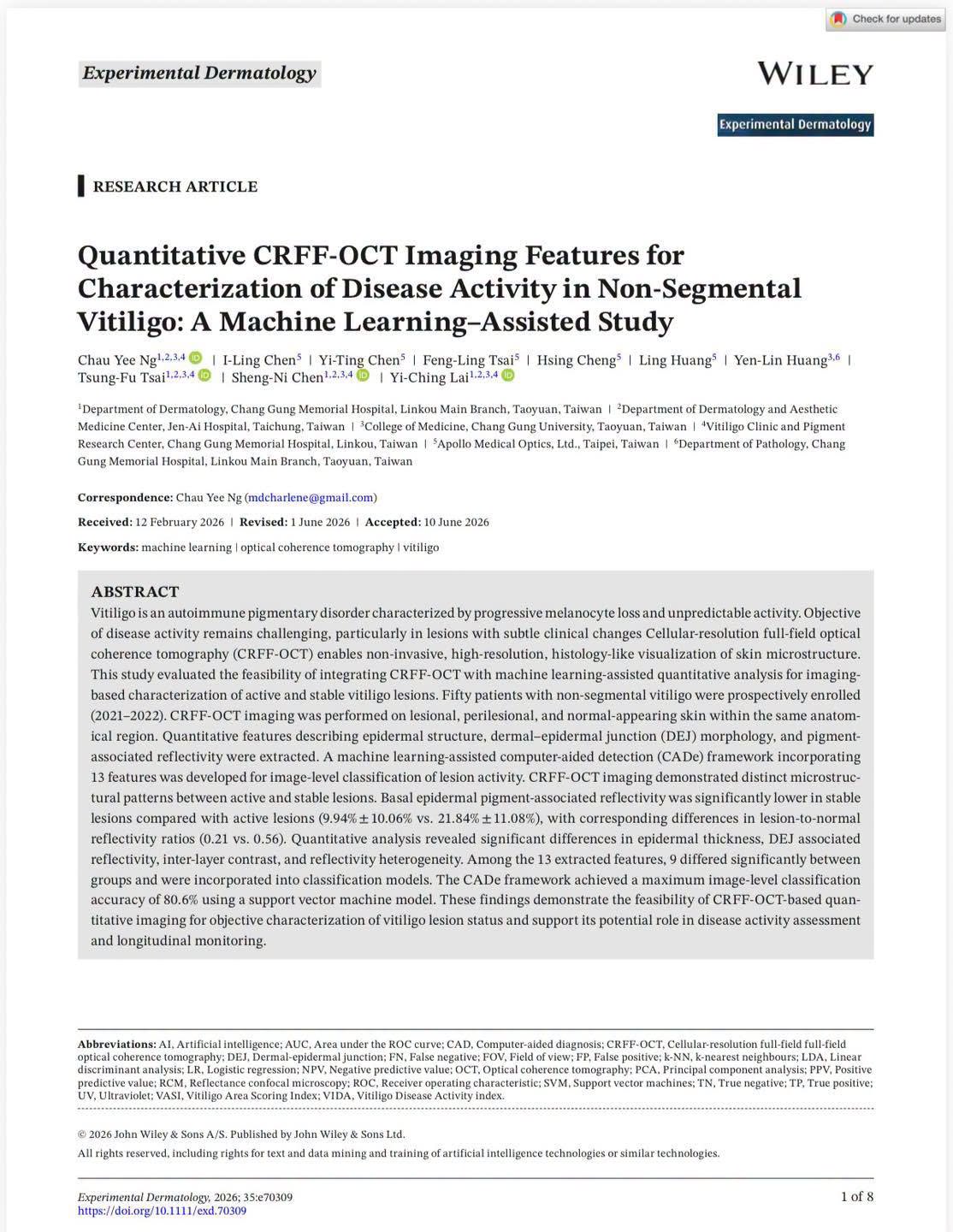
The Vitiligo Center has achieved another important milestone in vitiligo research. Led by Dr. Charlene C. Y. Ng, Director of the Center, the research team developed an objective disease activity assessment model for non-segmental vitiligo by integrating Cellular-resolution Full-field Optical Coherence Tomography (CRFF-OCT) with artificial intelligence (AI). The study provides a novel approach for objectively evaluating vitiligo disease activity and has been published in the international dermatology journal Experimental Dermatology.
Research Highlights
Determining whether vitiligo remains active is one of the greatest challenges in clinical practice. Although skin lesions may appear unchanged over time, the disease may still be immunologically active. Therefore, an objective method to assess disease activity is essential for guiding treatment decisions and long-term disease management.
In this study, the research team employed CRFF-OCT, a non-invasive high-resolution imaging technology, to investigate the microscopic structural characteristics of non-segmental vitiligo lesions. Quantitative image analysis revealed distinct differences between active and stable vitiligo, including:
-
Significant alterations at the dermal–epidermal junction (DEJ).
-
Differences in pigment reflectance patterns.
-
Distinct changes in epidermal microarchitecture.
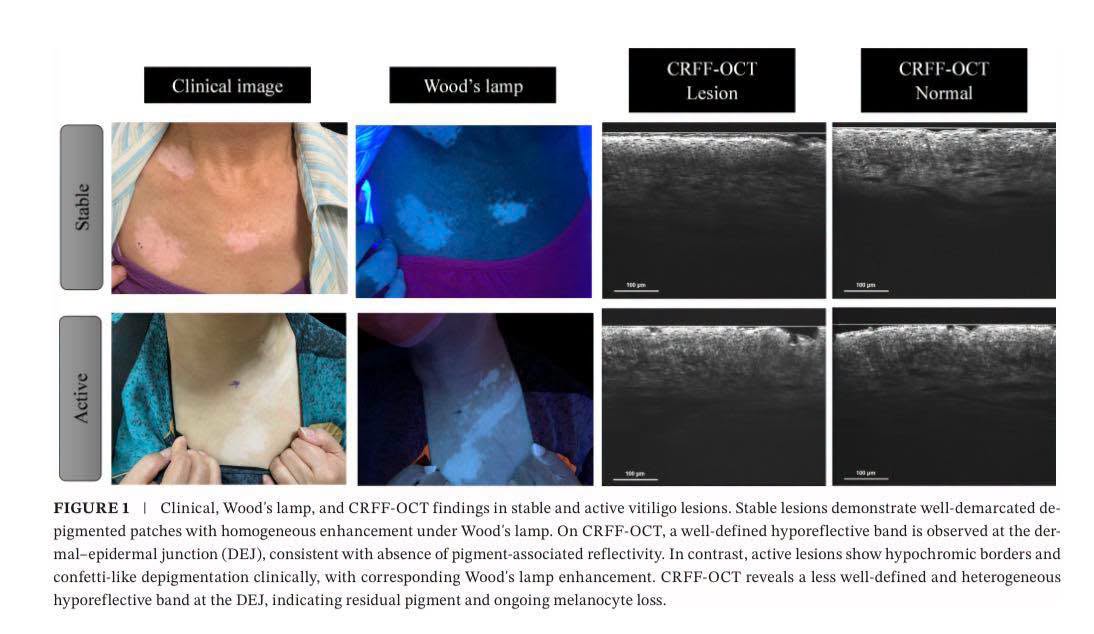
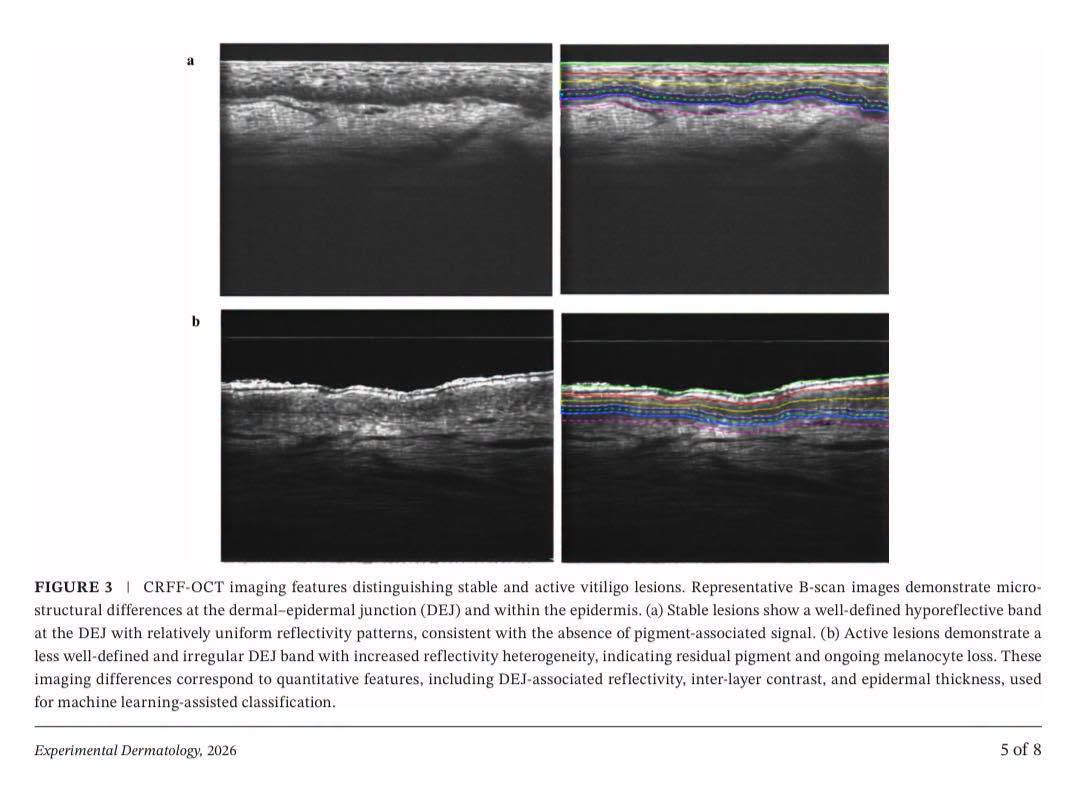
The team further incorporated artificial intelligence and machine learning algorithms to establish a predictive model capable of distinguishing active from stable vitiligo with approximately 80% accuracy, demonstrating the potential of quantitative CRFF-OCT imaging as an objective tool for disease activity assessment.
Clinical Significance and Future Perspectives
This study presents a non-invasive, quantitative, and objective approach for evaluating vitiligo disease activity. The proposed method may assist clinicians in determining disease status more accurately, optimizing treatment timing, monitoring therapeutic response, and improving long-term patient management.
Dr. Charlene C. Y. Ng noted that further validation through larger multicenter studies will be essential before clinical implementation. Nevertheless, the integration of CRFF-OCT and artificial intelligence represents a promising step toward precision medicine in vitiligo, with the potential to enhance the objectivity and consistency of disease activity assessment.
Acknowledgements
The research team sincerely thanks all collaborators and study participants whose contributions made this work possible. The Vitiligo Center remains committed to advancing both basic and translational research in vitiligo by integrating innovative imaging technologies and artificial intelligence, with the goal of providing more precise and personalized care for patients with pigmentary disorders.
Publication
Experimental Dermatology (2026)
Quantitative CRFF-OCT Imaging Features for Characterization of Disease Activity in Non-Segmental Vitiligo: A Machine Learning–Assisted Study
Link🔗 :https://onlinelibrary.wiley.com/doi/10.1111/exd.70309