
News & Events

- Home
- News
- Center Updates
- From Clinical Stability to Immunologic Stability: Identifying Factors Associated With Repigmentation After Vitiligo Grafting
From Clinical Stability to Immunologic Stability: Identifying Factors Associated With Repigmentation After Vitiligo Grafting
August 09,2026
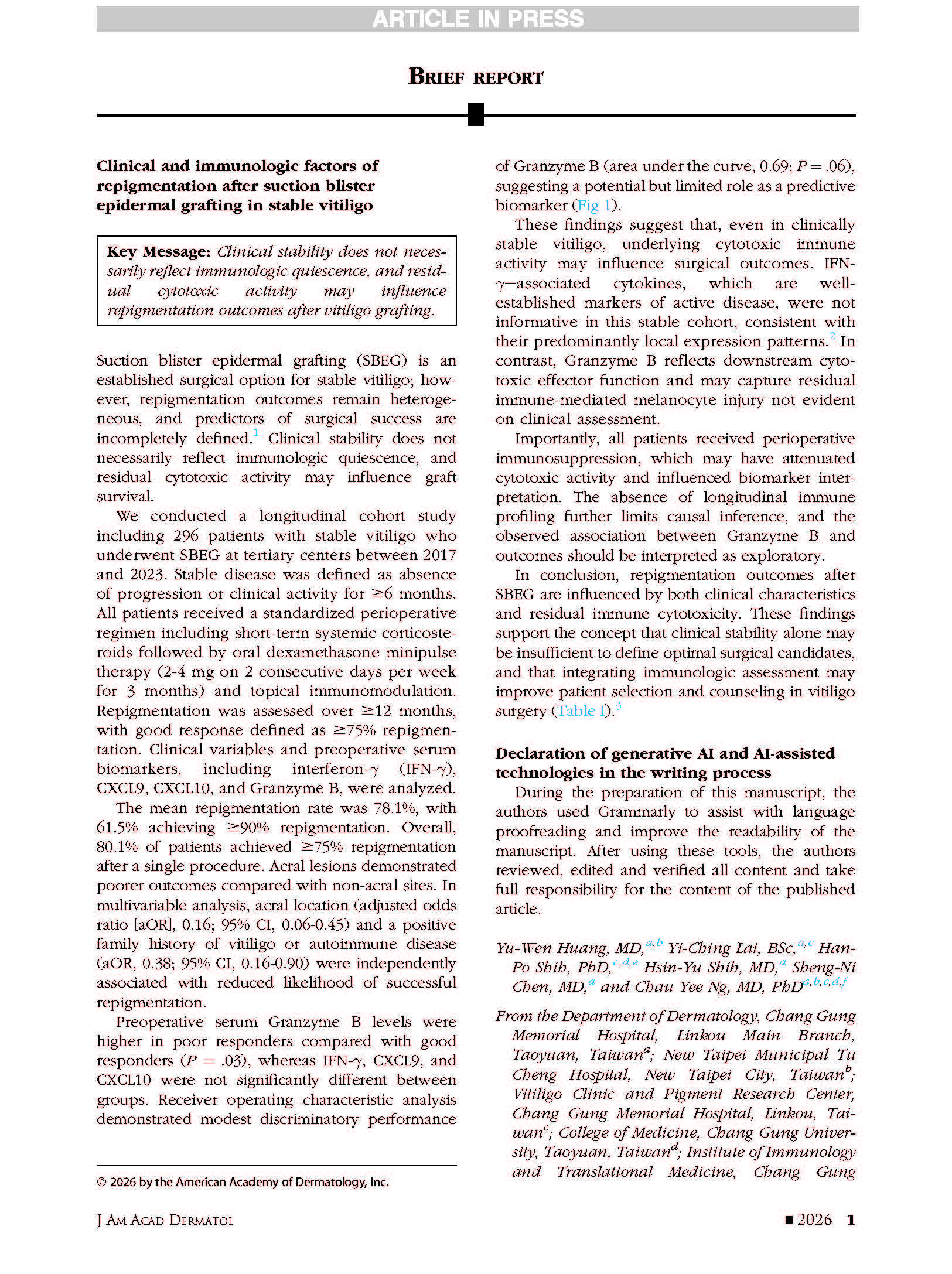
The Vitiligo Treatment Center (hereafter referred to as the Center) has achieved another important research milestone in vitiligo surgery and pigment regeneration. Led by Dr. Chao-Yu Huang, Director of the Center, the research team conducted a long-term analysis of patients with stable vitiligo who underwent suction blister epidermal grafting (SBEG) to investigate the clinical and immunologic factors associated with post-grafting repigmentation.
The findings provide new insights into patient selection and treatment timing for vitiligo grafting and have been formally published in the Journal of the American Academy of Dermatology (JAAD).
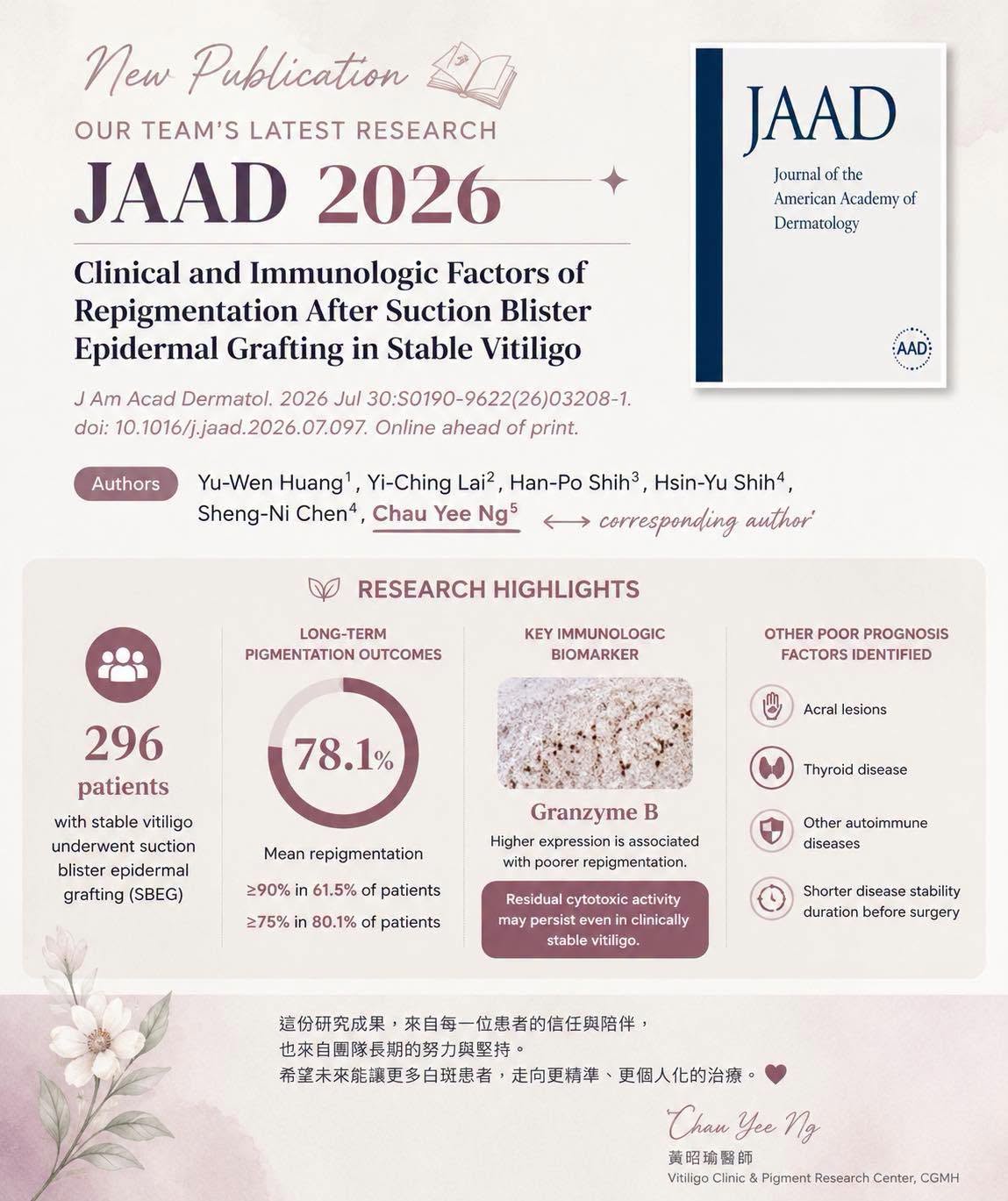
Key Findings
Vitiligo grafting is an important treatment option for patients with stable vitiligo. However, in clinical practice, repigmentation outcomes may vary considerably even among patients whose lesions have remained clinically stable for a prolonged period.
Therefore, beyond determining whether a patient meets the clinical criteria for disease stability, identifying factors that may influence post-grafting repigmentation and determining whether biological characteristics associated with treatment outcomes can be recognized before surgery remain important research questions in vitiligo surgery and precision medicine.
This study included nearly 300 patients with stable vitiligo who underwent suction blister epidermal grafting and were followed longitudinally to evaluate post-grafting repigmentation outcomes.
The study found that:
- The overall mean repigmentation rate was approximately 78%.
- Approximately 60% of patients achieved ≥90% repigmentation.
- Approximately 80% of patients achieved ≥75% repigmentation.
The research team further investigated the immunologic factors associated with grafting outcomes. The findings suggest that some vitiligo lesions considered clinically stable may still harbor residual cytotoxic immune activity within the skin.
In particular, Granzyme B expression was associated with less favorable repigmentation following grafting. These findings suggest that although some lesions may appear clinically stable, the local immune environment may not yet be completely immunologically quiescent.
The study also identified additional clinical prognostic factors associated with less favorable grafting outcomes, suggesting that post-grafting repigmentation may be influenced by multiple clinical and biological factors.
Clinical Significance and Future Perspectives
This study highlights an important concept in vitiligo management: clinical stability may not necessarily be equivalent to immunologic stability.
At present, clinical disease stability remains an important consideration when evaluating patients for vitiligo grafting. However, the findings of this study suggest that even when a lesion has shown no obvious clinical progression over time, residual immune activity within the skin may still influence melanocyte survival and subsequent repigmentation.
In the future, integrating clinical characteristics, disease stability, and immunologic biomarkers may help establish a more comprehensive approach to patient evaluation. Such an approach may support more precise identification of patients who are suitable candidates for vitiligo grafting and assist in determining the most appropriate timing for surgical intervention.
Dr. Chao-Yu Huang noted that the significance of this study extends beyond evaluating the success of vitiligo grafting. The findings also raise the possibility of predicting repigmentation outcomes before treatment. With further validation through larger-scale and multicenter studies, clinical and immunologic indicators may contribute to the development of more precise and personalized approaches to vitiligo surgical treatment.
Acknowledgments
The research team sincerely thanks all patients who participated in long-term follow-up, as well as the collaborating teams and research members whose contributions made this study possible.
The Center will continue to advance research into vitiligo disease mechanisms, pigment regeneration, and clinical translation. By integrating clinical observations with immunologic research, the team aims to further develop more precise approaches to disease assessment and personalized treatment strategies and ultimately improve the quality of care for patients with vitiligo.
Publication Information
Journal: Journal of the American Academy of Dermatology (2026)
Title: Clinical and Immunologic Factors of Repigmentation After Suction Blister Epidermal Grafting in Stable Vitiligo